Michigan Standard vs REAL ID vs Enhanced Licenses Compared
Choosing a Michigan license can feel like a travel decision disguised as a driver’s-license choice. The key is to separate what you need for driving from what you need at federal facilities or when returning to the United States across a land or sea border. This comparison explains the practical differences and helps you decide which credential fits your routine.
The short answer: what each credential does
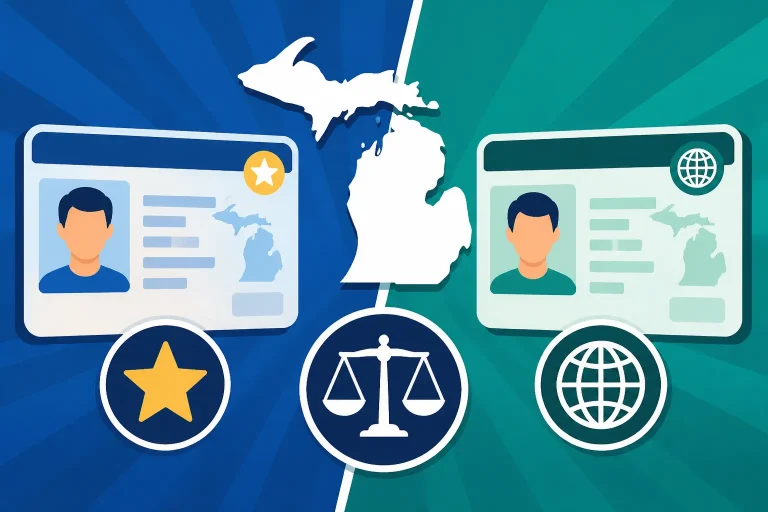
Michigan’s choices are easiest to compare by looking at the tasks you expect the card to handle. A standard license without a REAL ID indicator covers driving and ordinary identification, but not federal REAL ID requirements. A standard REAL ID license meets those requirements for specified uses. An enhanced license is also REAL ID-compliant and adds a passport-alternative use for certain international returns.
According to the Michigan Department of State, a standard license without a REAL ID indicator remains valid for driving and ordinary identification, but doesn’t meet federal REAL ID requirements. The department also says a standard REAL ID license has a star and can be used for domestic flights and certain federal facilities; an enhanced license is also REAL ID-compliant and additionally works as a passport alternative for U.S. re-entry by land or sea from Canada, Mexico, Bermuda, or the Caribbean.
That distinction gives you a useful starting point:
| Credential | Driving and ordinary identification | Federal REAL ID use described by Michigan Department of State | U.S. re-entry from listed destinations by land or sea |
|---|---|---|---|
| Standard license without a REAL ID indicator | Valid for driving and ordinary identification | Does not meet federal REAL ID requirements | No passport-alternative use is stated for this credential |
| Standard REAL ID license | A Michigan driver’s license | Has a star and can be used for domestic flights and certain federal facilities | No passport-alternative use is stated for this credential |
| Enhanced license | A Michigan driver’s license | Also REAL ID-compliant | Works as a passport alternative for U.S. re-entry by land or sea from Canada, Mexico, Bermuda, or the Caribbean |
The practical dividing line is not whether you can drive. The standard license without a REAL ID indicator remains valid for that purpose. The choice is about whether you want the card itself to meet the stated federal identification needs, and whether you also want the described border-reentry function.
An enhanced license is not simply another name for a REAL ID card. The Michigan Department of State describes it as REAL ID-compliant and gives it the additional passport-alternative role for U.S. re-entry by land or sea from the listed destinations. A standard REAL ID license has the star and the federal uses described above, but the department does not assign it that additional border function.
If you want a focused comparison of the federal and border features, see Choosing Between a Michigan REAL ID and an Enhanced Driver’s License. For the simplest overview, keep the three questions in mind: Does the credential meet your driving needs? Do you want a REAL ID-compliant card? Do you need the enhanced card’s stated land-or-sea re-entry use?
What “standard,” “REAL ID,” and “enhanced” mean in practice
These labels can sound like three levels of the same product, but that framing can lead to confusion. “Standard” describes the ordinary license option in this comparison. “REAL ID” identifies a standard license that has the federal compliance marker. “Enhanced” describes a separate credential that is also REAL ID-compliant and includes the additional border-reentry function described by the Michigan Department of State.
A standard license without a REAL ID indicator
This credential remains a valid Michigan driver’s license for driving and ordinary identification. Its limitation is specific: it doesn’t meet federal REAL ID requirements. If you do not need the card itself for the federal uses associated with REAL ID, that distinction may not affect your everyday driving.
Do not confuse “doesn’t meet federal REAL ID requirements” with “not a valid driver’s license.” The Michigan Department of State explicitly says the standard license without a REAL ID indicator remains valid for driving. The limitation concerns federal REAL ID requirements, not the ordinary act of driving.
For some cardholders, the standard option may be a reasonable fit if they need a driver’s license and are comfortable using another acceptable document when a federal identification requirement applies. The details of alternate documents and the rules of the place or service you are visiting are separate questions. Confirm those requirements with the relevant federal authority rather than assuming a non-REAL-ID license will be accepted for every purpose.
A standard REAL ID license
A standard REAL ID license is still a standard Michigan license, but it has a star and meets the federal REAL ID standard for the uses specified by the Michigan Department of State. The department says it can be used for domestic flights and certain federal facilities.
That makes it a practical option for someone who wants a driver’s license that also works for those stated federal purposes, without needing the enhanced card’s additional land-or-sea border function. The word “certain” matters: do not assume every federal building, service, or checkpoint has identical entry rules. Confirm the specific requirement before you travel or arrive.
The star is a useful visual marker, but it is not a substitute for checking what a particular trip requires. A card can meet the REAL ID standard and still not serve as the passport alternative described for an enhanced license. If your concern is travel to Canada or another destination named by the Michigan Department of State, read the border-use details separately.
An enhanced license
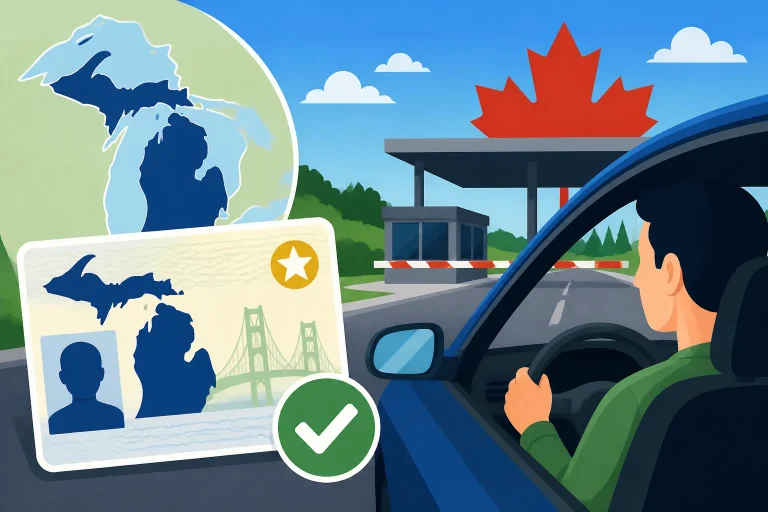
The enhanced license is also REAL ID-compliant. Its distinguishing feature is that it additionally works as a passport alternative for U.S. re-entry by land or sea from Canada, Mexico, Bermuda, or the Caribbean, according to the Michigan Department of State.
That description is specific about the direction of travel and the mode of entry. It concerns U.S. re-entry, by land or sea, from the listed places. It should not be stretched into a claim that the enhanced license replaces a passport for every international trip or every type of travel. Confirm the rules for your exact itinerary with the appropriate travel authority.
The enhanced license may be worth considering if you make the kinds of trips covered by the department’s description and want a credential that combines REAL ID compliance with that border use. If you do not expect to use that function, the standard REAL ID license may meet the federal identification need described here without selecting the enhanced option.
How to choose based on the way you travel
Start with your actual trips, not the most impressive-sounding label. A credential only helps when it matches the requirement you will encounter. Think through whether you mainly need a license for driving, whether you want the card itself to meet federal REAL ID requirements, and whether you make eligible land or sea returns from the places named by the Michigan Department of State.
If your priority is driving and everyday identification
The standard license without a REAL ID indicator may fit your needs if your priority is driving and ordinary identification. According to the Michigan Department of State, that license remains valid for driving and ordinary identification, even though it doesn’t meet federal REAL ID requirements.
Before choosing it, consider whether you will need the license itself for a domestic flight or entry to a federal facility. The department says a standard REAL ID license can be used for those specified purposes; it does not say that a standard license without the indicator meets the same REAL ID requirement. If you expect to need a compliant card, compare the standard REAL ID option instead.
The practical question is not whether you travel often in general. It is whether your likely travel includes a checkpoint or facility that requires a REAL ID-compliant credential and whether you plan to use your license as that credential. Review the requirements for your trip before deciding that you can rely on another form of identification.
If you need a card for domestic flights or certain federal facilities
A standard REAL ID license is the direct match for the federal use described by the Michigan Department of State: it has a star and can be used for domestic flights and certain federal facilities. This is the central reason many Michigan drivers compare a standard license with a REAL ID version.
Do not treat the phrase “certain federal facilities” as a guarantee of entry to every federal site. The facility can have its own rules, and the purpose of your visit may matter. Check the specific facility’s identification requirements before traveling there.
Likewise, for a flight, check the current identification requirements that apply to your route and circumstances. The department’s statement tells you what a standard REAL ID license can be used for; it does not provide a complete list of every accepted travel document or every special-case rule.
If you return to the United States by land or sea
If you return by land or sea from Canada, Mexico, Bermuda, or the Caribbean, the enhanced license has a specific additional use: it works as a passport alternative for U.S. re-entry, according to the Michigan Department of State. That is the main distinction to consider when comparing it with a standard REAL ID license.
If your trip is by air, do not assume that the enhanced license’s stated border function applies in the same way. The department’s description says “by land or sea.” Check the travel-document requirements for the exact mode and route you plan to use.
The eligible places named by the department also matter. Do not assume the card’s passport-alternative function applies to travel from every country or territory. For destinations beyond those listed, verify what travel documents are required before departure.
For practical context about travel with an enhanced license, see Driving to Canada With a Michigan Enhanced Driver’s License and Land Border Travel: Using Your Michigan Enhanced License for Canada. If your question is specifically whether a REAL ID card is enough for a Canada land crossing, Crossing into Canada: Why Michigan REAL ID Cards Fall Short addresses that distinction.
If you do not have a specific trip planned
You do not have to choose an enhanced license simply because it offers an additional function. If you have no foreseeable need for the stated land-or-sea re-entry use, the enhanced credential’s added feature may not be relevant to your daily life. On the other hand, if future travel is likely, it can be useful to compare the options before starting a transaction.
A helpful way to decide is to write down the situations where you expect to present your license: driving, ordinary identification, domestic air travel, entry to a federal facility, or U.S. re-entry by land or sea from a listed destination. Match each situation to the feature the Michigan Department of State assigns to the credential. If a requirement is uncertain, check with the authority that controls that trip or facility.
What the comparison does not tell you
A feature comparison cannot answer every question about applying for or holding a Michigan credential. It explains the differences stated by the Michigan Department of State, but it does not establish your personal eligibility, identify the documents you must present, or explain the current transaction process.
It does not establish eligibility
Do not assume that wanting an enhanced license means you automatically qualify for one. The distinction described here is about how the credential may be used, not the individual requirements for issuance. Before selecting an option, confirm eligibility and current application requirements with the Michigan Department of State.
For a focused document overview, see Documents Required for a Michigan Enhanced Driver’s License. If your main concern is proof of citizenship, Proving Citizenship for a Michigan Enhanced Driver’s License may help you identify the issue to verify with the department. Treat those topics as separate from the travel-use comparison.
It does not provide current costs or processing details
The information here does not give application costs, renewal charges, processing times, delivery estimates, or transaction methods. Those details can change and may depend on the service you need. Check the Michigan Department of State for current figures and instructions before making a decision based on cost or timing.
Also confirm whether you can complete the transaction through the channel you prefer. Some license services may require a different process from others, so avoid assuming that a standard license, a standard REAL ID license, and an enhanced license can all be obtained or renewed in precisely the same way.
If you have already decided on the enhanced option and are ready to review the official transaction topic, see Applying for an Enhanced License at Michigan Secretary of State. For a broader explanation of how REAL ID and enhanced credentials differ, Michigan REAL ID vs Enhanced Driver’s License: What Sets Them Apart is a related reference.
It does not make the enhanced license a universal passport substitute
The Michigan Department of State describes the enhanced license as a passport alternative for U.S. re-entry by land or sea from Canada, Mexico, Bermuda, or the Caribbean. Keep the boundaries of that statement intact. It is not a general statement that the card replaces a passport for all international travel, all destinations, or all modes of transportation.
Before a trip, confirm the required documents for each segment. A trip can include more than one mode of travel or more than one border crossing, and the document that works for one part may not be the right document for another. Verify the rules with the relevant travel authority, carrier, or border agency.
A practical decision checklist
Use the checklist below to make the comparison personal. It is not an application checklist; it is a way to identify which credential’s stated functions match your needs.
- You need a license for driving and ordinary identification. The Michigan Department of State says a standard license without a REAL ID indicator remains valid for those purposes.
- You want the license itself to meet federal REAL ID requirements. Compare the standard REAL ID license, which has a star and can be used for domestic flights and certain federal facilities according to the Michigan Department of State.
- You want the federal use and the described land-or-sea re-entry function. Consider the enhanced license, which the Michigan Department of State says is also REAL ID-compliant and additionally works as a passport alternative for U.S. re-entry by land or sea from Canada, Mexico, Bermuda, or the Caribbean.
- You are unsure whether a trip or facility accepts a particular credential. Confirm the requirement with the authority responsible for that trip or facility rather than relying on the credential name alone.
- You are choosing based on price, documents, or processing time. Check the Michigan Department of State for current details; those factors are not established by the feature comparison above.
- You do not expect to use federal identification or border functions. Decide whether the added features matter to you, while remembering that the standard license without a REAL ID indicator remains valid for driving and ordinary identification.
The checklist often makes the answer clear. Drivers who only need a license for driving may not need the additional federal functions. Drivers who want a card for domestic flights or certain federal facilities should compare standard REAL ID. Drivers who also need the enhanced license’s stated land-or-sea U.S. re-entry feature should weigh that credential against their itinerary and confirm the requirements for the trip.
Common comparison mistakes to avoid
Treating REAL ID and enhanced as interchangeable
An enhanced license is REAL ID-compliant, but that does not make the terms interchangeable. According to the Michigan Department of State, a standard REAL ID license has a star and can be used for domestic flights and certain federal facilities. The enhanced license is also REAL ID-compliant and additionally has the specified passport-alternative use for U.S. re-entry by land or sea from the listed destinations.
The extra function is the reason to examine the enhanced credential separately. If you only compare the cards as “compliant” or “not compliant,” you may miss the border-related distinction.
Assuming a standard license is invalid for driving
The absence of a REAL ID indicator does not make the standard license invalid for driving. The Michigan Department of State says a standard license without a REAL ID indicator remains valid for driving and ordinary identification. Its limitation is that it does not meet federal REAL ID requirements.
This is an important distinction if you already have a standard license and are wondering whether you need to replace it immediately. The information here does not establish a deadline or tell you when a replacement is required for your personal situation. Check the relevant requirements for the trip or facility that prompted your question, then consult the Michigan Department of State about any transaction you decide to make.
Assuming an enhanced license works for every international trip
The enhanced license’s described passport-alternative use has stated boundaries: it is for U.S. re-entry by land or sea from Canada, Mexico, Bermuda, or the Caribbean. Do not widen that statement to cover every destination or travel mode. Check the requirements for your actual route, including any connecting travel.
Choosing based on the label instead of the use
“Enhanced” can sound like the obvious choice, but the name alone does not establish that it is the best option for every driver. The right fit depends on whether you need the additional feature. If you will not use the stated border-reentry function, compare the standard REAL ID option on its own merits. If your travel plans include the covered land-or-sea return, make sure you understand the enhanced license’s scope before relying on it.
Confusing a card’s stated use with a guarantee of acceptance
The credential descriptions are useful, but a particular facility, trip, or travel route may have details that are not covered by this comparison. Check the relevant rules where you will present the card. This is especially important when your travel includes an unusual itinerary, multiple modes, or a destination beyond those listed by the Michigan Department of State.
Frequently Asked Questions
Is a Michigan standard license without a REAL ID indicator still valid for driving?
Yes. The Michigan Department of State says a standard license without a REAL ID indicator remains valid for driving and ordinary identification. It does not meet federal REAL ID requirements.
Can a standard REAL ID license be used for domestic flights?
The Michigan Department of State says a standard REAL ID license has a star and can be used for domestic flights and certain federal facilities. Confirm current requirements for your specific trip.
What does an enhanced license add?
According to the Michigan Department of State, an enhanced license is also REAL ID-compliant and additionally works as a passport alternative for U.S. re-entry by land or sea from Canada, Mexico, Bermuda, or the Caribbean.
Does an enhanced license replace a passport for every trip?
No such broad claim is established here. The Michigan Department of State describes the enhanced license as a passport alternative for U.S. re-entry by land or sea from the listed destinations. Check the requirements for your exact destination and mode of travel.
Sources
- Michigan Department of State — Licenses and ID (checked November 11, 2026)
Disclaimer
This article is for general informational purposes only and does not constitute professional advice. Laws, prices and regulations vary by location and change over time. Consult a qualified professional for guidance on your specific situation. Michigan Driver Guide is not a government agency and is not affiliated with any state motor vehicle department.