Switching to a Michigan Driver’s License After Moving
Moving to Michigan brings a handful of practical tasks, and transferring your driver’s license is one that can be easy to underestimate. The right steps depend on whether your current license is valid, where it was issued, and what type of Michigan credential you want. Here’s how to prepare, what to expect at the Michigan Secretary of State, and when extra testing or paperwork may apply.
When to Transfer Your License
If you establish residency in Michigan, you generally need to obtain a Michigan driver’s license within 30 days. The clock is tied to becoming a resident, not simply to the date you first visit or temporarily stay in the state. If your plans or circumstances make your residency status unclear, check with the Michigan Secretary of State (SOS) before relying on your old license indefinitely.
A temporary visit is different from a permanent move. People visiting Michigan, including many students and temporary workers, may be able to keep a valid license from their home jurisdiction while they are here. But the right answer depends on the person’s situation. Do not assume that an out-of-state address, a college enrollment, or a short-term lease automatically settles whether you are a Michigan resident.
The transfer process is generally for a person who holds a current license issued by another U.S. state or jurisdiction. The SOS will review your identity, residency, and license status, and may require you to surrender your previous credential when Michigan issues a license. For a broad overview of the new-resident process, see New Resident Checklist: Michigan SOS Driver Licensing Steps.
Your situation may differ if your old license is expired, suspended, revoked, restricted, or issued outside the United States. Those cases can require additional review or testing, so it is worth identifying the issue before you book a visit.
A quick decision guide
| Your situation | What to expect |
|---|---|
| Current, valid U.S. license with no restrictions | Usually the simplest transfer; expect identity and residency checks and a vision screening. |
| Expired license | The SOS may require knowledge or road testing, depending on the license history and applicable rules. |
| Suspended or revoked license | A new Michigan credential may be blocked until the underlying problem is resolved. |
| License from another country | Do not assume the same test waivers apply as for a U.S. state license. Ask the SOS what evidence and tests are required. |
| Teen license or learner permit | Michigan’s graduated licensing rules may affect which credential you qualify for and what records are needed. |
| Want to cross into Canada or meet federal identification requirements | Compare a standard license, REAL ID-compliant license, and enhanced license before applying. |
A move does not erase a suspension or other restriction from your driving history. If there may be an active problem, read Will an Out-of-State Suspension Block a New Michigan License? before planning around a routine transfer.
Prepare Your Documents Before Booking
The most common reason a transfer visit goes poorly is not a complicated licensing rule; it is arriving without enough acceptable paperwork. The SOS must verify who you are and that you are eligible for the credential you requested. The exact documents depend on your circumstances and the type of license, so use the current official document requirements as your checklist rather than relying on a friend’s older experience.
Collect the main document groups
Be ready to provide documents that establish the following:
- Identity and legal presence. The SOS needs acceptable evidence of your identity and legal presence in the United States. The required evidence can vary based on your citizenship or immigration status.
- Social Security number or applicable documentation. Bring the proof requested for your situation. If you do not have a Social Security number, check the SOS instructions for what alternative documentation or statement is accepted.
- Michigan residency. You may need documents showing your Michigan residential address. Make sure the documents meet current requirements and show your actual residence, not just a mailing address.
- Your existing driver’s license. Bring the physical out-of-state credential if you have it. If it is lost, stolen, expired, or otherwise unavailable, tell the SOS and confirm what substitute evidence is acceptable.
- Additional evidence for a special credential. REAL ID and enhanced licenses have requirements beyond a basic identity-and-residency check. Review those requirements before choosing the credential.
For a more detailed preparation list, see Essential Checklist: Documents for a Michigan Driver’s License. If you are transferring an out-of-state license, Out-of-State License Conversion: Step-by-Step SOS Guide can help you organize the overall process.
Make names and addresses match
Check each document for a consistent legal name and current address. A recent marriage, divorce, court-ordered name change, or other legal change can mean you need a linking document to explain why records do not match. If your license uses a different name from your identity documents, do not assume the SOS can resolve the discrepancy without supporting paperwork.
Your Michigan residency documents should also tell a coherent story. If you recently moved and most of your accounts still show your former address, ask the SOS which documents it accepts and whether you need to update records first. A lease, utility account, or other record may be useful only if it meets the agency’s current rules.
Bring original documents when the official checklist calls for them. A photograph of a document on your phone is not automatically an acceptable substitute. If a document is digital, check whether the SOS accepts that format before your appointment.
If you do not have a birth certificate
A birth certificate is not the only possible way to establish identity or citizenship, and the specific alternatives depend on the credential and your circumstances. If you cannot locate a birth certificate, do not delay all preparation until you find one. Instead, compare the SOS’s accepted documents with what you have and ask whether another combination will work.
This matters especially if you want an enhanced license. The enhanced credential has additional evidence requirements, so the documents that are sufficient for a standard license may not be sufficient for an enhanced one. See Transferring an Out-of-State License Without a Birth Certificate and Proving Citizenship and Identity for a Michigan License Transfer if those are relevant to your situation.
Do not guess about the document count
The number and kind of documents required can vary by transaction and credential. Avoid relying on a general rule such as “one bill is enough” or “two pieces of mail always work.” Verify the current checklist for your specific transfer and credential, then bring the required documents in the form the SOS accepts.
It is also sensible to bring extra supporting paperwork when a name, address, or status change is recent. Extra documents cannot guarantee approval, but they may help explain a record mismatch. Keep them organized so the documents needed for the transaction are easy to find.
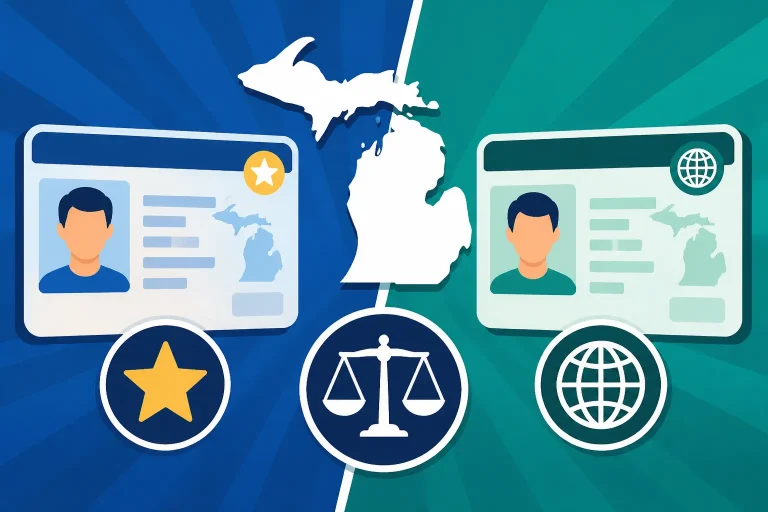
Choose the Michigan Credential That Fits Your Needs
A new resident does not have to choose the most specialized credential available. The best option depends on how you use identification and whether you want a credential that supports particular travel purposes. Consider the choice before your visit, since changing the credential type can affect which documents you need.
Standard Michigan driver’s license
A standard driver’s license authorizes driving for the class of vehicle shown on the credential, subject to any restrictions. It may be the straightforward choice if you mainly need a Michigan license for driving and already have another acceptable form of identification for travel or federal purposes.
A standard license is not automatically the same thing as a REAL ID-compliant license. Look for the credential’s marking and check the SOS’s current explanation of the options. If federal identification is a concern, compare Michigan Standard vs REAL ID vs Enhanced Licenses Compared before you apply.
REAL ID-compliant license
A REAL ID-compliant license is designed to meet federal identification requirements for certain purposes, including use at airport security checkpoints when a state-issued credential is presented as identification. A compliant credential is not a passport and does not replace every document needed for travel.
If your current license does not meet your needs, ask the SOS whether you can request a REAL ID-compliant credential as part of the transfer and what additional documents are necessary. Do not assume that a license is compliant just because it was recently issued; check the actual marking and the agency’s current guidance.
Enhanced driver’s license
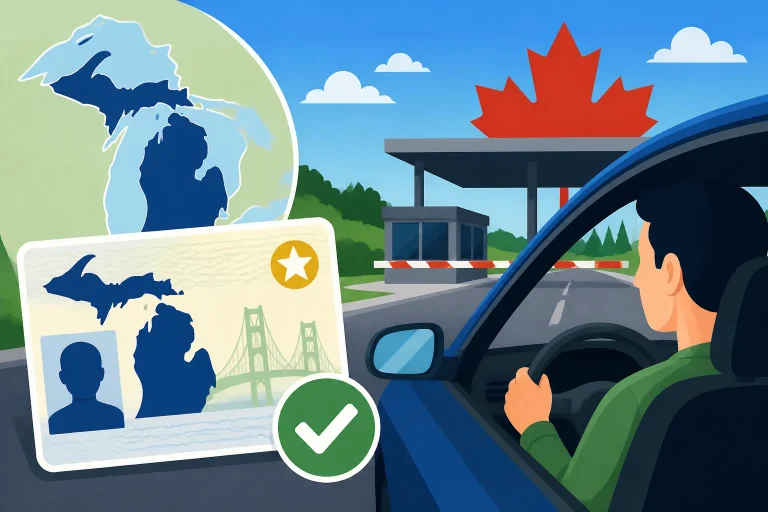
Michigan’s enhanced driver’s license is a separate credential with additional eligibility and document requirements. It can be useful for eligible U.S. citizens who want a credential that can serve certain land and sea border-crossing purposes between the United States and Canada, Mexico, Bermuda, and the Caribbean. It is not a substitute for a passport for air travel.
The enhanced option may take more preparation because the SOS must verify additional information. If the enhanced credential is your goal, review Michigan REAL ID vs Enhanced Driver’s License: What Sets Them Apart and Documents Required for a Michigan Enhanced Driver’s License before making an appointment.
| Credential choice | A practical reason to consider it | What to check |
|---|---|---|
| Standard license | You need a Michigan driving credential and have other identification for travel or federal purposes. | Whether the credential’s features meet your identification needs. |
| REAL ID-compliant license | You want a state-issued credential that meets federal identification requirements for applicable uses. | The required documents and the compliance marking on the card. |
| Enhanced license | You are eligible and want an enhanced credential for qualifying land or sea border crossings. | Citizenship and identity evidence, eligibility, and the limits on how it can be used. |
The enhanced license is not automatically the best choice just because it offers more functionality. If you do not need its travel features, the additional documentation may not be worth the extra preparation. Conversely, if you want to use it for eligible border travel, deciding only after you arrive at the branch could mean another visit.
Schedule and Complete the Transfer
A new-resident transfer normally requires an in-person visit to the Michigan Secretary of State. Online license services may handle some renewals, replacements, or updates, but do not assume they can complete a first Michigan license transfer. Check the current SOS transaction options and appointment instructions before choosing a branch.
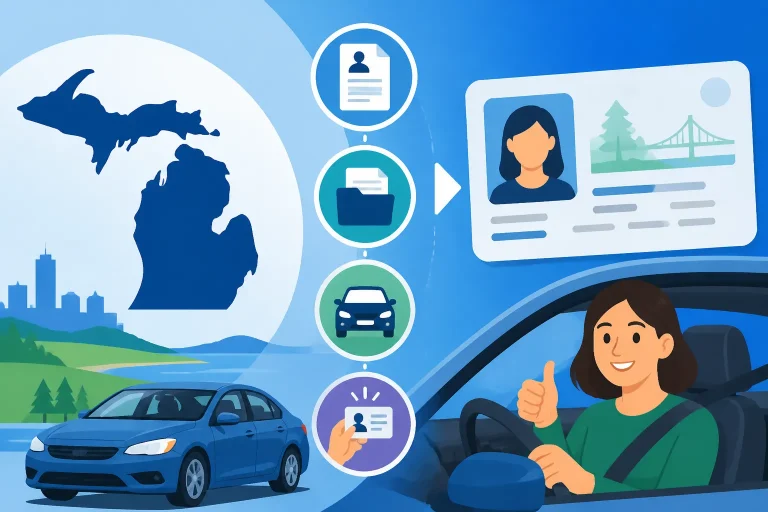
Step-by-step preparation
- Confirm your transfer category. Determine whether you hold a current U.S. license, an expired license, a learner permit, a teen credential, or a license from another country. The answer affects the process and possible testing.
- Check for holds or restrictions. Review whether your license is suspended, revoked, or subject to a restriction. If it is, address that issue before treating the visit as a routine transfer.
- Choose the credential type. Decide whether you want a standard license, a REAL ID-compliant license, or an enhanced license. Compare their document requirements first.
- Gather current documents. Use the SOS’s official checklist for your specific situation. Check names, dates, and residential addresses for inconsistencies.
- Select a branch and appointment option. Use the official Michigan Secretary of State appointment process and office locator to find an appropriate branch and its current hours. Availability and appointment procedures can change.
- Attend the visit with your documents and current license. Follow the branch’s check-in instructions. The SOS will review your eligibility and determine whether additional steps apply.
- Complete any screening or testing required. A vision screening is common, and the SOS may require knowledge or road testing depending on your record and situation.
- Confirm how you may drive while the card is being produced. If the agency issues temporary driving documentation, follow its validity period and restrictions. Do not assume an appointment receipt or application confirmation is permission to drive.
- Watch for delivery and follow up if needed. Confirm your mailing address and ask what status-checking options are available. A mailed card can take time, and delivery estimates are not a substitute for checking official instructions.
For help choosing the right appointment category and getting ready for a visit, see Booking an SOS Appointment to Transfer an Out-of-State License. If your move also involves vehicle paperwork, remember that a license transfer and vehicle registration or title transaction may have separate requirements. A single visit may not cover every service unless you confirm that in advance.
What happens at the branch
The SOS reviews your documents and the information associated with your existing license. The agency may verify your identity, legal presence, residency, license status, and driving record. It may also take a photograph, perform a vision screening, collect the applicable transaction fee, and ask you to surrender your old license.
If a record does not match, the branch may not be able to complete the transfer immediately. For example, a name discrepancy, an unresolved suspension, or missing evidence can require additional documents or agency review. Ask what specifically remains outstanding and what evidence will resolve it; a general instruction to “bring more paperwork” is not enough to prepare for a return visit.
The fee depends on the credential and transaction. Check the Michigan Secretary of State’s current fee information rather than relying on a previous applicant’s receipt or an old online post.
Testing and Special Situations
A valid license from another U.S. state often makes a transfer simpler because written and road tests are generally waived for eligible drivers. That does not mean every applicant is guaranteed a waiver. The SOS determines what tests apply after reviewing the license, its status, and the applicant’s circumstances.
Valid out-of-state license
If your current license is valid and your driving privileges are not suspended or restricted, expect the SOS to verify it and determine whether testing is waived. A vision screening may still be required. Answer questions about your license history accurately, including any restrictions, endorsements, or recent changes.
If you want a fuller explanation of how waivers work, read Convert an Out-of-State License to Michigan Without Retesting. The key point is that “no retesting” is a common outcome for eligible applicants, not a promise that every move leads to the same result.
Expired license
An expired license can change the transfer process. The amount of time since expiration, the jurisdiction that issued it, and the available driving record may matter. Depending on the circumstances, the SOS may require a knowledge exam, a road skills test, or both.
Do not renew an old license elsewhere or let it expire further just to simplify the move without checking which option is appropriate. Requirements can depend on where you are currently considered a resident and what evidence the SOS accepts. For more detail, see Moving to Michigan: What Happens If Your Old State License Expired?.
Suspended, revoked, or restricted license
A Michigan license cannot be treated as a simple replacement for driving privileges that are suspended or revoked elsewhere. An unresolved out-of-state action can prevent issuance, and a restriction may affect what Michigan can issue. If the issue is in an old jurisdiction, contact the responsible authority there and obtain confirmation of what is needed to clear it.
Keep records of any clearance or reinstatement. Do not rely solely on a verbal assurance that a case is closed if the driving record still shows a hold. Before visiting, find out whether the SOS needs updated electronic records, a formal clearance document, or another step.
License from another country
A foreign license is not necessarily handled like a valid license from another U.S. state. The SOS may need to review the credential, any translation or supporting records, and the applicant’s eligibility. Testing can be required, and the exact process depends on the license and the documentation available.
If your foreign license is in a language the agency cannot readily verify, ask what translation or other documentation it accepts before scheduling. Bring the original credential and any supporting paperwork requested by the SOS. Do not assume that an international driving permit, if you have one, can replace the original license or satisfy a Michigan transfer requirement.
Teen drivers and learner permits
A teen moving to Michigan may not simply exchange a license and receive an equivalent card. Michigan uses a graduated driver licensing system for drivers under 18, and a teen’s prior permit, education, supervised practice, and driving experience may affect the next step.
Gather the teen’s current license or permit, driver education records, and any practice documentation that may be relevant. Ask the SOS how the teen’s existing credential fits Michigan’s requirements before assuming the teen can move directly to an unrestricted license. Start with Teen Graduated Driver Licensing: Navigating Every GDL Stage or Transferring an Out-of-State Teen License to Michigan.
Out-of-state endorsements
A motorcycle or commercial endorsement may not transfer in exactly the same way as a basic passenger-vehicle license. Bring the current credential and any relevant qualification records, and ask the SOS whether the endorsement can be transferred or whether additional testing, medical evidence, or documentation is needed.
Do not assume an endorsement is preserved just because the basic license transfers. If you rely on a commercial or motorcycle credential for work or regular riding, resolve the endorsement question before driving in that capacity.
After the Transfer: Your Card, Driving, and Records
Once the SOS approves the application, follow the instructions it gives you about temporary documentation and the permanent card. The permanent license may be mailed rather than printed at the branch. Confirm that your address is correct before leaving, especially if you are staying temporarily or moving again soon.
Driving while you wait
Only drive if your existing driving privilege remains valid or the SOS has issued temporary documentation that authorizes you to drive. A receipt, appointment confirmation, or proof that you applied is not automatically a temporary license.
If the old license has been surrendered, ask the SOS what document you should carry and when it expires. Keep any temporary credential with you and follow its conditions. If it is lost or its validity period is nearing an end, contact the SOS through its official service channels instead of guessing.
If delivery is taking longer than expected, use the official status-checking method available for your transaction. Make sure the mailing address you provided can receive the card. For card-delivery questions, see Tracking Your Michigan Driver’s License Delivery Status Online.
Update your address if you move again
A new resident’s first Michigan license should show the correct Michigan residential address. If you move after applying, determine whether the address change needs to be made before the card is mailed or through a separate update process. A forwarded envelope may not solve the problem, and a card sent to an old address can create a replacement task.
After the license is issued, update the record when your address changes. The process and whether a new card is issued can depend on the type of transaction. See Updating Your Michigan Driver’s License Address Through e-Services for an explanation of address updates.
Keep vehicle tasks separate
Getting a Michigan driver’s license does not necessarily complete the related tasks for your vehicle. Registration, title, plates, and insurance records have their own rules and paperwork. If you are moving a vehicle to Michigan, check those requirements separately and plan for the possibility that the license and vehicle transactions require different documents or appointments.
This separation is useful when planning your first few weeks in the state. For instance, a valid Michigan license does not by itself prove that a vehicle has been properly titled or registered, and vehicle paperwork does not replace a driver’s license transfer.
If you are turned away or the transaction is delayed
Ask the branch what blocked the transfer and what action will resolve it. Write down the exact document name, record issue, or test requirement. If the problem involves an out-of-state driving record, ask whether the SOS needs the other jurisdiction to update a record or whether you must provide formal proof.
Before making another trip, check that you have the missing evidence in an accepted form and that any required clearance has been recorded. If the issue is a test, confirm whether it must be scheduled through a branch or a testing provider. Different issues call for different next steps, so a general assumption that “the system will update soon” can cost time.
For a complete new-resident overview beyond the license itself, Moving to Michigan: What to Expect When Transferring Your License can help you identify the other decisions to handle after your move.
Frequently Asked Questions
Do I need to take a road test to transfer my out-of-state license?
Many people with a current, valid U.S. license qualify for a testing waiver, but it is not automatic. The SOS reviews your license status and circumstances and decides whether a knowledge or road test is needed. An expired, suspended, or foreign license may require additional testing.
Do I have to surrender my old driver’s license?
The SOS may require you to surrender your previous license when issuing a Michigan credential. Bring the physical card and follow the branch’s instructions. If you do not have it, tell the agency before your appointment and ask what substitute evidence it accepts.
Can I complete the transfer online?
A first-time Michigan transfer generally requires an in-person visit for document review and other required steps. Online services may support other driver’s license transactions, but check the current SOS options rather than assuming a transfer can be completed remotely.
Should I get a REAL ID or an enhanced license?
It depends on how you plan to use the credential. A REAL ID-compliant license can meet federal identification requirements for applicable purposes. An enhanced license has additional eligibility and documentation requirements and can be used for certain land and sea border crossings. Neither is a passport, and an enhanced license is not a substitute for a passport for air travel.
What if my license is suspended in my former state?
Do not assume Michigan can issue a new license while an out-of-state suspension or hold remains active. Contact the authority responsible for the suspension, resolve the issue, and confirm that the clearance is reflected in the record the SOS reviews before applying.
Disclaimer
This article is for general informational purposes only and does not constitute professional advice. Laws, prices and regulations vary by location and change over time. Consult a qualified professional for guidance on your specific situation. Michigan Driver Guide is not a government agency and is not affiliated with any state motor vehicle department.