New Resident Checklist: Michigan SOS Driver Licensing Steps
Moving to Michigan means more than changing your mailing address: you need to transfer your driver’s license through the Michigan Department of State. The timing can catch new residents off guard, and document requirements are easy to underestimate. Use this checklist to plan the application, prepare for the office visit, and avoid relying on assumptions about what the state will accept.
Start the license transfer when you establish Michigan residency
According to the Michigan Department of State, new residents must apply as soon as they establish Michigan residency—there’s no grace period. That makes the residency change the point to plan around, not the date your old license expires or the next time you happen to visit a Secretary of State office.
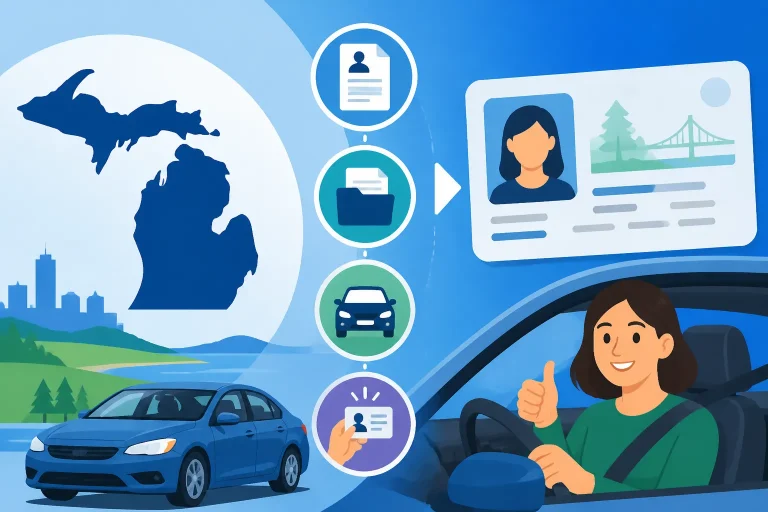
The Department’s stated process is straightforward when you have a valid out-of-state license: pre-apply online, schedule a Secretary of State office visit, bring the required documents, complete a vision test, and have your photo taken. The Department says no written test is required, and the photo license is mailed in about two weeks. Requirements can depend on your individual circumstances, so check the Michigan Department of State’s current instructions before making the trip.
Treat residency as the trigger, not the move-in date alone
A move can unfold in stages. You might arrive first, stay temporarily, and later make Michigan your home. The important question is when you establish Michigan residency, because that is the trigger described by the Michigan Department of State. If it is unclear whether your circumstances amount to establishing residency, ask the Department rather than assuming that a temporary arrangement delays the requirement.
This distinction matters for people who move for work, school, family, or a longer-term change of home. A planned move date and the date you actually settle into Michigan may not be the same. Keep track of your circumstances and get guidance from the Department if you are unsure which date applies to you.
For broader context on what transferring involves, see Moving to Michigan: What to Expect When Transferring Your License. If you are comparing several parts of the move, New Resident Checklist: Michigan SOS Driver Licensing Steps is this article’s subject, so use the linked companion topics below for specific questions rather than assuming one general checklist covers every situation.
Don’t wait for the old license to become a problem
A valid out-of-state license is part of the document checklist for the process described by the Department. Waiting until it is expired, lost, or otherwise difficult to present can make your transfer less straightforward. If any of those issues apply, first review Moving to Michigan: What Happens If Your Old State License Expired? or Lost Your Only ID? Steps to Replace a Michigan Driver’s License. Those situations deserve separate attention; do not assume the ordinary transfer steps will resolve them automatically.
If your license is suspended or you have a hold in another state, pause before treating your application as a routine transfer. Review Moving to Michigan With a Suspended Out-of-State Driver’s License and confirm your eligibility with the Michigan Department of State. A license card in your wallet does not necessarily answer every question about your driving status.
Pre-apply and arrange the office visit
The Michigan Department of State directs new residents to pre-apply online and schedule a Secretary of State office visit. Plan for both parts. Pre-applying is not a substitute for the office visit in this process, and a scheduled visit does not make missing documents irrelevant. Use the time before your appointment to check the Department’s current instructions and assemble the evidence it asks you to bring.
If you need help with the appointment portion, see Booking an SOS Appointment to Transfer an Out-of-State License. The key is to choose an appointment category that matches a new-resident license transfer and follow the official booking system’s directions. If the available choices are unclear, check the Department’s guidance rather than selecting a category based on a guess.
Complete the pre-application carefully
Use the pre-application process to provide the information requested by the Michigan Department of State. Enter your details carefully, especially the information that must match your identity and documents. A typo or a mismatch can lead to delays or require clarification at the office.
Before submitting, take a moment to check that you have used your current information and that you can access any confirmation or instructions the Department provides. Keep a copy or record of relevant details in a place you can retrieve easily. If a question does not fit your situation, do not invent an answer just to get through the form. Look for the Department’s explanation or ask the Department how to proceed.
Pre-application details should be treated as preparation, not proof that the transfer has been completed. You still need to attend the Secretary of State office visit and bring the required evidence. Avoid making plans that depend on receiving a permanent Michigan license before the Department has completed the process.
Make the appointment useful
When arranging the visit, check the official Department instructions for the transaction, appointment availability, and any current office requirements. Do not rely on old appointment advice from someone whose circumstances may have been different. If you need to locate an office, use the Michigan Department of State’s official office locator to find the nearest office and confirm its current hours.
Think through practical details before leaving: do you have the required documents, can you reach them easily, and do you understand what the visit is for? If a document is missing or your license is not valid, it is better to clarify the next step with the Department before traveling to an office than to assume the issue can be handled at the counter.
For general preparation, Checklist for Michigan Secretary of State: What Documents to Bring can help you think about organizing paperwork for an office visit. The new-resident requirements listed here still control your transfer planning, and the Department’s current instructions should settle questions about acceptable evidence.
Gather every required document before you go
According to the Michigan Department of State, bring your valid out-of-state license and proof of legal presence, Social Security number, identity, and Michigan residency (two documents). Treat each category as a separate requirement when organizing your paperwork. Do not assume that one document will satisfy several categories unless the Department confirms that it does.
The labels are broad, and the exact documents accepted can depend on the Department’s current rules and your circumstances. That is why it is safer to check the Michigan Department of State’s official document guidance than to rely on a generic list, a friend’s experience, or a document that was accepted for a different transaction.
Use a category-by-category checklist
Set up a checklist with a separate line for each required category:
- Valid out-of-state driver’s license.
- Proof of legal presence.
- Proof of Social Security number.
- Proof of identity.
- Proof of Michigan residency, including two documents.
Mark each category only after you have identified the document or documents you plan to present and checked that they meet the Department’s current requirements. This simple separation helps catch a common planning error: bringing several pieces of paperwork while still missing proof for one specific category.
For a more detailed overview of document preparation, see Essential Checklist: Documents for a Michigan Driver’s License. If your main concern is identity or citizenship evidence, Proving Citizenship and Identity for a Michigan License Transfer may help you frame the question to verify with the Department. These resources can help you organize your preparation, but the Michigan Department of State determines which documents it accepts.
Check the details, not just the document names
Before the appointment, compare the information on your documents. Names, dates, and addresses may need explanation if they differ across records. A name change, recently changed address, or inconsistent spelling does not automatically tell you which evidence the Department will accept. Check the official requirements and ask the Department what supporting paperwork is needed for your specific situation.
Also confirm whether a document must be current, whether a particular format is accepted, and whether the Department requires an original or another form of presentation. Do not assume that a photocopy, a digital image, or an expired document will work simply because it contains the relevant information. The Department’s instructions are the authority for acceptable forms of evidence.
For Michigan residency, make sure you understand the requirement for two documents before your visit. Do not count a document toward that category until you have confirmed that it qualifies under the current Department rules. If your housing or living arrangement makes the usual proof difficult to provide, look for the Department’s guidance on alternative documentation and ask what applies to your circumstances.
Keep papers together and easy to review
Place the documents you plan to use in one folder or another secure place, and keep them organized by category. This makes it easier to notice a missing item and answer questions during the visit. Avoid leaving important papers in a packed moving box, a vehicle, or a location you cannot access on appointment day.
Keep sensitive information secure. Only provide information through the Michigan Department of State’s official process, and be cautious of unexpected messages that ask for personal details or payment. If you are uncertain whether a request is genuine, contact the Department through its official channels rather than responding to the message.
If you discover that one item is missing, do not assume another document can replace it. Check the official document guidance or contact the Michigan Department of State before the appointment. Getting a clear answer beforehand is more useful than arriving with a substitute the Department may not accept.
Know what happens at the Secretary of State office
The office visit is a required part of the new-resident process described by the Michigan Department of State. Bring the documents you prepared, follow the Department’s check-in directions, and be ready to complete the steps required for your application. For this process, the Department says you’ll take a vision test and have your photo taken.
According to the Michigan Department of State, no written test is required for the process described for new residents. That is useful to know when planning your visit, but it does not mean every licensing situation has the same requirements. If your out-of-state license is not valid or your record has a complication, confirm the process for your case before assuming the standard transfer steps apply.
Be ready for the vision test
The Department says new residents will take a vision test at the office. If you use corrective lenses or have a vision-related concern that could affect the screening, plan to discuss it with the Department and follow its instructions. Do not assume that a prior test in another state will replace the screening in Michigan.
The screening is one reason to avoid treating the visit as a document drop-off. You will need to be present and able to complete the steps the Department requires. If you have questions about how to prepare for the screening or whether your circumstances need additional documentation, ask the Department before the appointment.
For related information about the screening step, see Transferring to a Michigan License: Vision Test and Required Papers. The Department’s directions for your transaction remain the best guide if your situation differs from a routine transfer.
Expect a photo as part of the process
The Department also says your photo will be taken during the office visit. Follow its instructions about the photo and any identity checks. If you have a concern that could affect identification or the photo process, raise it with the Department rather than relying on assumptions about exceptions.
Your permanent photo license is not handed over as part of the steps described here. According to the Michigan Department of State, the photo license is mailed in about two weeks. That is an approximate delivery timeframe, not a promise that every delivery will arrive on the same schedule. Make sure the address information on your application is correct and ask the Department what to do if the card does not arrive when expected.
Ask before leaving if something is unclear
Before you finish the visit, make sure you understand what happens next and whether the Department has given you any temporary document or instructions. Do not assume a temporary paper credential is issued in every case, or that it can be used for every purpose. Follow the information the Department provides for your transaction.
If an employee identifies a missing document or a mismatch, ask what specific item or correction is needed. Clear instructions can save you from repeating the process based on guesswork. If your application cannot be completed that day, ask what to do next, whether you need another appointment, and which documents you should bring.
Decide what license credential fits your needs
A transfer is also a useful time to think about which Michigan credential you want, but do not confuse that choice with the basic transfer requirements. The new-resident steps described by the Michigan Department of State focus on applying, presenting documents, completing the vision test, and having your photo taken. The correct credential for you depends on what you need it to do and on the Department’s current eligibility and documentation rules.
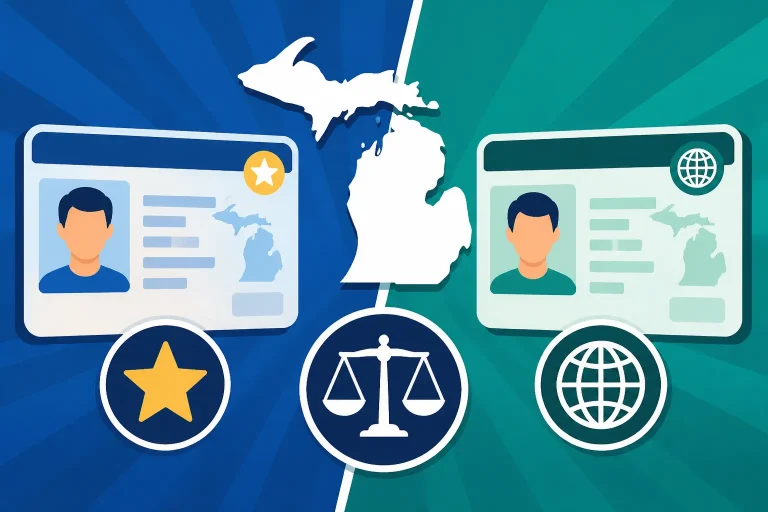
Michigan offers different license credential types, and terms such as standard, REAL ID, and enhanced can be easy to mix up. Before choosing, decide what matters in your situation: whether you need a credential for a particular type of travel, whether you want a federal-compliant credential, or whether a standard license meets your needs. Then verify the current distinctions with the Michigan Department of State.
For a comparison of the main options, read Michigan Standard vs REAL ID vs Enhanced Licenses Compared and Michigan REAL ID vs Enhanced Driver’s License: What Sets Them Apart. Those topics can help you understand what to ask, but do not treat a comparison as confirmation that you qualify for a particular credential or that your existing documents meet its requirements.
Don’t assume every credential uses the same paperwork
The document list for a new-resident transfer should not be confused with the additional evidence that might apply when requesting a particular credential type. If you are considering an enhanced license, check Documents Required for a Michigan Enhanced Driver’s License and confirm the current requirements directly with the Michigan Department of State. Do not assume the transfer documents automatically cover every credential option.
If you are leaning toward a REAL ID, review the Department’s current requirements and consider whether you need to change your choice before the application is completed. Ask whether the documents you have prepared support the specific credential you want. Settling that question before the appointment may help you avoid a second visit or a later credential change.
A practical way to decide is to list the uses that matter to you, compare them with the Department’s official descriptions, and select the credential based on your needs—not on a shorthand label or someone else’s preference. If you are unsure, ask the Department what each option means for your intended use.
Keep travel questions separate from licensing steps
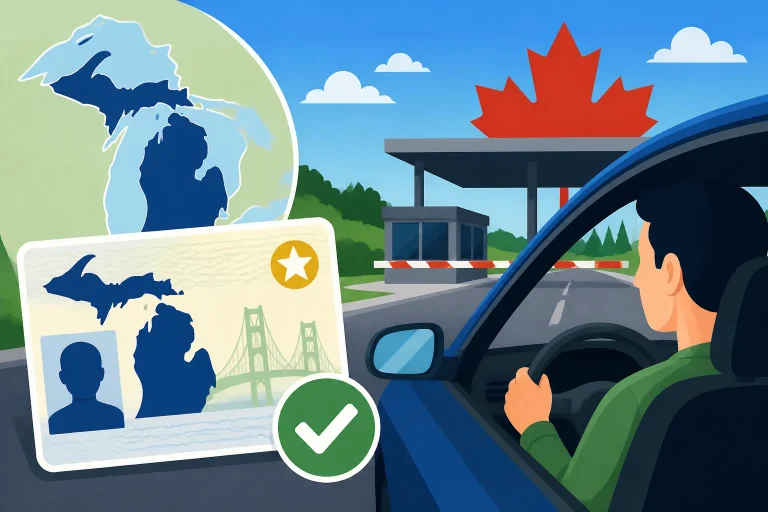
A Michigan driver’s license transfer and travel eligibility are related but not identical questions. If you are choosing a credential because you travel to Canada, review Driving to Canada With a Michigan Enhanced Driver’s License or Land Border Travel: Using Your Michigan Enhanced License for Canada. Verify the current travel and document rules with the appropriate official sources before a trip.
Avoid assuming that any Michigan license works for every travel purpose. A credential’s name alone may not answer whether it meets a specific requirement. Check the rules for the trip you are planning and make sure the identification you intend to use is accepted for that situation.
Plan for the period after your office visit
After the visit, follow any instructions the Michigan Department of State gives you. The Department says the photo license is mailed in about two weeks. Keep in mind that this is an approximate timeline; do not make a critical plan that depends on the card arriving on a particular day.
Before leaving the office, confirm that the Department has the right mailing address and ask what to do if your card is delayed or does not arrive. If the Department provides a way to check the card’s status, use its official service. For help with delivery questions, see Tracking Your Michigan Driver’s License Delivery Status Online or How to Use Michigan SOS e-Services to Check License Mailing Dates.
Understand what you can use while waiting
The steps and any temporary credentials available can depend on your transaction. Do not assume that your out-of-state card remains acceptable for every purpose after you establish Michigan residency, or that an application receipt gives you driving privileges. Ask the Michigan Department of State what you may use while your Michigan card is being produced and what conditions apply.
If you receive a temporary paper credential, read its limits and follow the directions printed on it or supplied by the Department. Do not rely on a general description of temporary credentials to answer a question about your specific document. For more on this issue, see How Long Can You Drive on a Michigan Temporary Paper License?.
If your permanent card does not arrive within the timeframe the Department has provided, check the official status or contact the Department for instructions. Make sure your mailing address is still accurate and report any delivery problem through the Department’s official process. Avoid submitting another replacement request before checking whether the original card is already in production or in transit.
Keep your transfer records
Keep a record of your appointment confirmation, the information the Department gives you, and any temporary credential or receipt. Store these securely with other important documents. This can help you answer questions if you need to check your application status or explain the timing of your transfer.
If you move again before the card arrives, check with the Department about updating your mailing address. A pending license transaction and a general address update may not be interchangeable. The Michigan Department of State can tell you which process applies and whether changing the address affects delivery.
Once you receive the card, check its printed details promptly. If you see an error, follow the Department’s instructions for correcting it. Keep your prior license and other records safe until the Department tells you what to do with them; do not assume you should discard or surrender a document unless the Department directs you to.
Handle exceptions before treating your case as routine
The checklist above is designed for a new resident following the process described by the Michigan Department of State. Some situations need additional attention: an expired or missing out-of-state license, a suspension or hold, a name mismatch, difficulty providing proof of Michigan residency, or a question about which credential to request. The more your circumstances differ from the standard case, the more important it is to confirm the process before booking or attending an appointment.
If your old license is expired, missing, or unavailable
The Department’s stated checklist calls for a valid out-of-state license. If you cannot present one, do not assume that the same transfer steps will apply unchanged. Review Switching to a Michigan Driver’s License After Moving and Replacing a Lost Michigan Driver’s License Without Visiting an Office for related situations, then confirm with the Michigan Department of State what evidence or testing applies to your case.
If your former license is expired, there may be separate questions about whether it can be transferred and whether any testing is required. See Lapsed License Retesting Rules When Moving to Michigan and ask the Department to assess your circumstances. Avoid relying on an old credential or an online summary without checking whether it is valid for the transaction you are requesting.
If the card is lost, stolen, or inaccessible, first determine what the Michigan Department of State accepts instead of it. A police report, photocopy, or digital record should not be assumed to substitute for the required credential unless the Department says so.
If your record has a suspension or hold
A suspension or hold can change what you are eligible to do. If you have an unresolved issue in Michigan or elsewhere, disclose it when asking the Department about the transfer and follow its instructions. Do not treat getting a Michigan card as a way to bypass a restriction imposed on your driving record.
For an out-of-state issue, Will an Out-of-State Suspension Block a New Michigan License? can help identify the right question to ask. If the concern is a Michigan restoration matter, Guide to Administrative Driver License Restoration and Appeals may be relevant. These situations are distinct from an ordinary transfer and should be resolved through the appropriate official process.
If your documents do not line up
A difference between your current name, prior license, and supporting paperwork may require extra evidence. The same is true if you do not have the usual documents for Michigan residency. Before the appointment, ask the Michigan Department of State what it accepts in your circumstances and whether you need to bring additional records.
Do not make last-minute substitutions based on another person’s experience. One person’s accepted document may not fit your case or the Department’s current rules. If the answer is not clear from the official instructions, contact the Department and describe the exact issue so you can prepare the right paperwork.
If you are a student or have a special move situation
Students and people with temporary or unusual housing arrangements may have questions about when they establish Michigan residency and what documents can prove it. Do not assume that enrollment, a dorm address, or a family address automatically settles the question. Check with the Michigan Department of State about your own circumstances.
For students, College Student Driver’s Licenses: Required Michigan SOS Paperwork may help you identify the relevant issues. If your move involves a teen driver, different rules may apply; review Moving to Michigan with an Out-of-State Teen Learner’s Permit or Transferring an Out-of-State Teen License to Michigan. Adult new-resident steps should not be applied to a teen’s licensing situation without checking the separate requirements.
Frequently Asked Questions
Do I need to transfer my license immediately after moving?
According to the Michigan Department of State, new residents must apply as soon as they establish Michigan residency—there’s no grace period. If you are uncertain when you established residency, ask the Department how its requirement applies to your situation.
Do new residents have to take a written test?
According to the Michigan Department of State, no written test is required for the new-resident process described here. If your license is expired, missing, or affected by a suspension or hold, confirm whether your circumstances change the steps.
What should I bring to the office?
According to the Michigan Department of State, bring your valid out-of-state license and proof of legal presence, Social Security number, identity, and Michigan residency (two documents). Check the Department’s current document rules before your appointment.
How long does it take to receive the Michigan photo license?
According to the Michigan Department of State, the photo license is mailed in about two weeks. The timeframe is approximate, so ask the Department what to do if the card does not arrive as expected.
Can I complete the transfer without visiting an office?
The new-resident process described by the Michigan Department of State includes pre-applying online and scheduling a Secretary of State office visit. Check the Department’s current instructions for your transaction before assuming that an online step completes the transfer.
Sources
- Michigan Department of State — New Michigan residents (checked November 11, 2026)
Disclaimer
This article is for general informational purposes only and does not constitute professional advice. Laws, prices and regulations vary by location and change over time. Consult a qualified professional for guidance on your specific situation. Michigan Driver Guide is not a government agency and is not affiliated with any state motor vehicle department.