Out-of-State License Conversion: Step-by-Step SOS Guide
Moving to Michigan means more than changing the address on your old license: you may need to transfer your driving credential, show identity and residency documents, and visit a Secretary of State office. This step-by-step overview explains how to prepare, what can affect testing, and when a separate issue may delay the transfer.
Before you start: check your license and situation
A Michigan license transfer is usually simpler when your out-of-state license is valid and your driving privilege is clear. Before making an appointment, check the expiration date and confirm that the license has not been suspended, revoked, canceled, or restricted. Also make sure you know whether you are transferring an ordinary driver’s license or seeking a different credential, such as an enhanced license.
The exact requirements depend on your circumstances, so use the Michigan Secretary of State’s current instructions to confirm what applies to you. The process can differ if your license is expired, you have a driving hold in another state, you cannot provide standard identity documents, or you are under 18.
| Your situation | What to consider before booking |
|---|---|
| Valid license from another U.S. state | Prepare identity and Michigan residency documents; ask whether testing is required for your case. |
| Expired out-of-state license | Find out whether the length of the lapse changes the testing or application requirements. |
| Suspended, revoked, or restricted license | Resolve the issue or ask the Secretary of State how it affects eligibility before treating this as a routine transfer. |
| License from another country | Confirm which documents and driving tests apply; rules may differ from a transfer between U.S. states. |
| Under 18 | Check how Michigan’s graduated driver licensing system applies to your age and previous driving experience. |
| Seeking an enhanced license | Review the separate citizenship, identity, and residency requirements before choosing the credential. |
A valid license from another state may allow you to avoid some tests, but do not assume every transfer is test-free. The Secretary of State decides what is required based on your record and documents. For an overview of the general transfer process, see Out-of-State License Conversion: Required Steps for New Residents. For details on testing waivers, see Converting an Out-of-State License: Skipping Road and Written Tests.
If your old license has expired, do not assume it will be treated like a current credential. The length of the lapse and your driving history may affect what you need to do. Start with Moving to Michigan: What Happens If Your Old State License Expired? and confirm your situation with the Secretary of State before you travel to a branch.
Step 1: Confirm which Michigan credential you need
Most people transferring an ordinary out-of-state license seek a Michigan operator’s license. But the right credential depends on how you plan to use it and what documents you can provide.
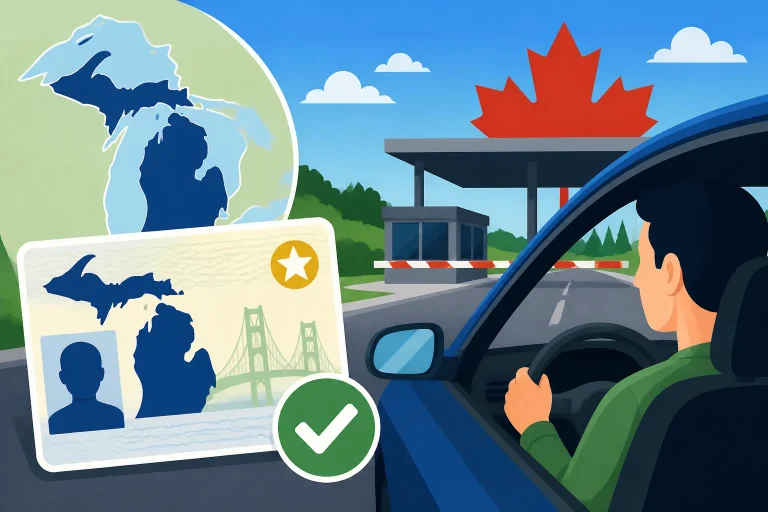
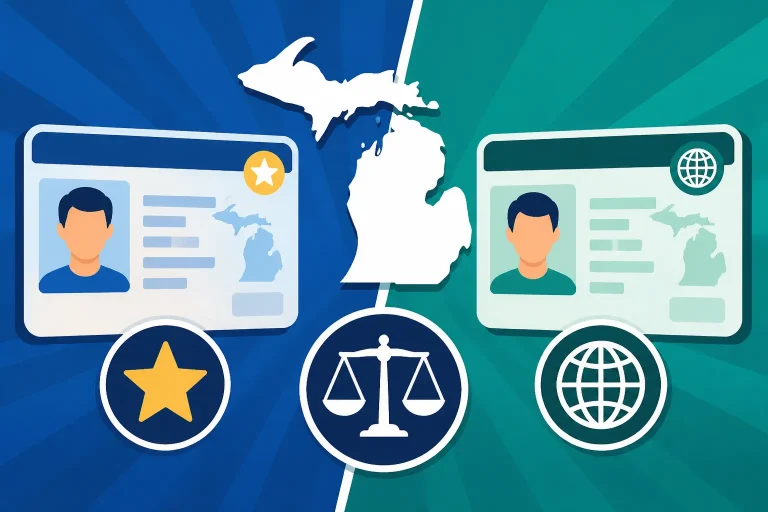
A standard license may be enough for everyday driving. If you want a credential with enhanced border-crossing privileges, you will need to meet additional requirements and apply for an enhanced license. A REAL ID-compliant credential and an enhanced license are not interchangeable for every purpose, so compare the options before deciding. Michigan Standard vs REAL ID vs Enhanced Licenses Compared explains the differences, while Choosing Between a Michigan REAL ID and an Enhanced Driver’s License can help you weigh travel needs against documentation requirements.
If you are applying for a commercial license, motorcycle endorsement, or chauffeur credential, this is not simply a standard license conversion. Those credentials can involve separate qualifications, endorsements, or testing. See Commercial and Chauffeur Driver Licensing: Endorsements and Rules or Transferring an Out-of-State Motorcycle Endorsement to Michigan if either applies.
Your credential choice can affect the papers you need to bring. An enhanced license, for example, has additional proof requirements. If you are considering one, check Documents Required for a Michigan Enhanced Driver’s License before scheduling the visit. Do not select a credential based only on the card design or on what you held in your previous state.
Step 2: Gather documents before you book
Prepare the documents before choosing an appointment. Missing or unsuitable paperwork is one of the most avoidable reasons a transfer visit can stall. Michigan’s requirements can depend on the credential you want and your personal circumstances, so check the current Secretary of State document list rather than relying on an old checklist or another state’s rules.
You may need documents that establish:
- Your identity and date of birth.
- Your legal presence in the United States, when applicable.
- Your Social Security number or the required documentation for your situation.
- Your Michigan residency.
- Your current or previous driver’s license.
The Secretary of State’s accepted-document rules are specific. A document that seems useful may not count for the category you need, and an online image or photocopy may not be accepted where an original or another format is required. Check the current instructions for each document type and bring the required form of the document.
Residency can be a point of confusion for people who have just moved. A lease is not the only possible way to show where you live, but you must use evidence the agency accepts. If you do not have a lease or utility bill in your name, see Establishing Michigan Residency for a Driver’s License Without a Lease. For a broader checklist of acceptable document groups, see Essential Checklist: Documents for a Michigan Driver’s License.
If your name differs across documents, bring the records that explain the difference, such as a document showing a legal name change, if applicable. Check whether the Secretary of State needs the original document or a certified version. Do not assume that a marriage certificate, court record, or other paperwork will be accepted for every purpose without checking the agency’s instructions.
Before booking, organize the documents by purpose and review them for consistency. Check that names, dates, and addresses match or can be explained. If you have more than one acceptable proof for a category, bringing an additional document may help if the first one is not accepted. That does not replace checking the current list, but it can reduce the chance of a second trip.
Step 3: Choose and book the right branch visit
An out-of-state license transfer generally requires an in-person visit. The branch needs to review your documents and complete the parts of the transaction that cannot be handled as a routine online update. Use the Michigan Secretary of State’s official appointment system to select the service that matches a new-resident license transfer.
Choosing the wrong appointment category can make the visit harder to complete. Read the options carefully and select the one that describes transferring an out-of-state license, rather than renewal, replacement, or an unrelated service. For appointment-specific help, see Booking an SOS Appointment to Transfer an Out-of-State License and Which SOS Appointment Option to Pick When Moving to Michigan.
Before confirming a booking, make sure you know:
- Which branch you are visiting and the appointment details.
- Which original documents you need to bring.
- Whether the transaction requires a test or screening.
- Whether you need to surrender your previous license.
- Which payment methods the branch accepts and what the current transaction cost is.
Costs and accepted payment methods can change, so confirm them with the Secretary of State rather than relying on an old receipt or a third-party estimate. To find a branch and check its current hours, use the official agency’s office locator. This guide is independent and cannot book, change, or complete an appointment for you.
If you cannot find a suitable appointment, review the agency’s current instructions for available options. Do not assume that a walk-in can be completed on the same day; branch procedures and availability can vary. Finding Open Michigan Secretary of State Appointment Slots Online offers practical appointment-search tips, and Checklist for Michigan Secretary of State: What Documents to Bring can help you prepare for the visit.
Step 4: Complete the transfer at the Secretary of State office
At the branch, staff will review your application and documents, check the information needed for your license record, and tell you whether any additional steps apply. Expect to present your out-of-state license and the documents required for your selected Michigan credential.
A typical visit may include:
- Document review. The branch checks whether your identity, residency, and other required documents meet the current rules.
- Application and record checks. You provide the information needed for the new license and the agency reviews your driving eligibility.
- Vision screening. A vision screening may be part of the in-person process. If you use corrective lenses, bring them and follow the agency’s instructions.
- Testing, if required. Depending on your license status and record, you may need to complete a knowledge test, road skills test, or another required step.
- Previous-license handling. The agency may require you to surrender your out-of-state credential when issuing a Michigan one. Ask the branch how this applies to your case and plan for the possibility that you will not keep using the old card.
- Payment and temporary credential. If your application is approved, the branch will explain the next steps, including any temporary credential and how the permanent card will be delivered.
The order and details can vary, and not every applicant will complete the same steps. In particular, a valid license from another state does not automatically guarantee a waiver of all testing. Review Transferring to Michigan: Vision Test and Required Papers and Transferring to Michigan: Out-of-State Knowledge and Road Waivers to understand what may be checked.
Be ready to explain any issue that does not match a routine transfer, including a legal name change, expired card, restriction, or unresolved suspension. Do not leave out a problem because it occurred in another state. The agency may need to verify your driving record before it can issue a Michigan credential.
If you are asked to take a test, follow the instructions provided by the Secretary of State about how and where to complete it. A road skills test may involve a separate appointment or approved examiner rather than being completed at the branch counter. Confirm the current process before making plans. If you are new to testing in Michigan, Driver Testing Overview: Written Knowledge and Road Exam Rules describes the general distinction between knowledge and road skills testing.
Step 5: Handle delays, holds, and special cases
A transfer can take longer when the record check raises a question or a required document is missing. The best response is to find out exactly what is blocking the transaction and which agency or record needs attention.
If your old license is expired
The expiration date matters, but it may not be the only factor. A long lapse can change whether the agency treats your situation as a straightforward conversion or asks you to complete additional testing. Confirm the current requirements before you travel, especially if your license expired well before your move. Lapsed License Retesting Rules When Moving to Michigan covers this issue in more detail.
If your driving privilege is suspended elsewhere
An out-of-state suspension or hold can prevent a new Michigan license from being issued until the underlying matter is cleared or reviewed. This is different from simply transferring the physical card. Ask the Michigan Secretary of State what it needs to verify and contact the relevant authority in the state that placed the restriction. You may also find Will an Out-of-State Suspension Block a New Michigan License? useful.
Do not drive on the assumption that a pending transfer or an old card gives you permission to drive if your privilege is suspended, expired, or otherwise invalid. Confirm your current driving status before getting behind the wheel.
If you cannot prove residency in a standard way
People in temporary housing, students, and recent movers may not have bills or a lease in their own name. That does not mean you should bring paperwork at random. Check the Secretary of State’s accepted options for your specific situation and make sure the documents establish Michigan residency in the required way. Students can also review College Student Driver’s Licenses: Required Michigan SOS Paperwork.
If you are under 18
Michigan uses a graduated driver licensing system for teen drivers. An out-of-state teen license may not convert in exactly the same way as an adult license, because the agency may need to determine which Michigan GDL stage fits the driver’s age and prior credentials. Review Transferring an Out-of-State Teen License to Michigan and confirm which parent or guardian must attend, if anyone, before booking.
If your license is from another country
A license issued outside the United States may require different documents and testing from a license issued by another U.S. state. Translation, identity, legal-presence, and driving-history questions may come up. Ask the Secretary of State what it accepts for your situation before assuming that the out-of-state transfer rules apply.
After the visit: temporary credentials and other moving tasks
If the Secretary of State approves the transfer, follow the instructions you receive about using any temporary credential and receiving the permanent card. Delivery timing can vary, so keep any temporary paperwork safe and check that your mailing address is correct. If the card does not arrive within the timeframe the agency provides, use its official status-check options or contact the Secretary of State.
A driver’s license transfer does not automatically complete your vehicle paperwork. If you own a car, vehicle title, registration, plate, and insurance requirements are separate matters. Ask the agency which tasks can be completed together and what documents are needed. New Resident Checklist: Michigan SOS Driver Licensing Steps covers the broader move-related licensing process, while Michigan Vehicle Registration: Requirements, Fees, and Steps explains the separate registration side.
Changing your driver’s license address later also does not necessarily update every vehicle or other state record. If you move again within Michigan, check which records need separate updates. For license address changes, see Updating Your Michigan Driver’s License Address Through e-Services.
Frequently Asked Questions
Do I need to take a driving test to transfer my license to Michigan?
Not necessarily. A valid out-of-state license may qualify for a testing waiver, but the Secretary of State determines what applies based on your license status, record, and documents. Confirm before your appointment.
Can I transfer an expired out-of-state license?
Possibly, but an expired license can change the process and may lead to additional testing or requirements. The length of the lapse and your driving record matter, so check with the Secretary of State before booking.
Do I have to give up my old license?
Be prepared for the Secretary of State to require you to surrender your previous license as part of issuing a Michigan one. Ask the agency how it will handle your particular credential and whether any exception applies.
Is an out-of-state license transfer the same as registering my car in Michigan?
No. The driver’s license transfer and vehicle title or registration work are separate transactions, even if you arrange them around the same move. Check the requirements for each.
Disclaimer
This article is for general informational purposes only and does not constitute professional advice. Laws, prices and regulations vary by location and change over time. Consult a qualified professional for guidance on your specific situation. Michigan Driver Guide is not a government agency and is not affiliated with any state motor vehicle department.